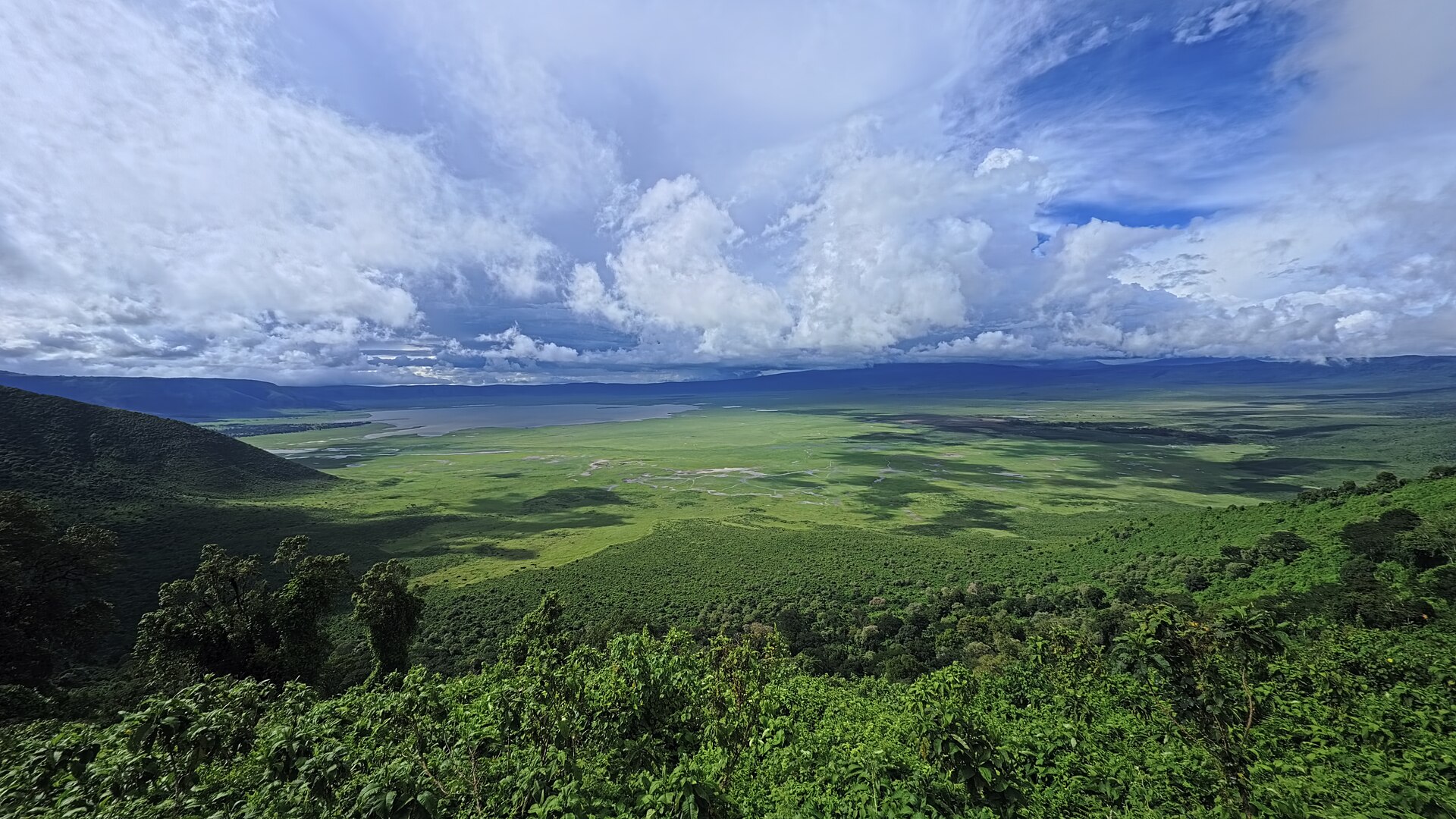
The Ngorongoro Crater is the easiest place in Tanzania to see a great deal, fast. Roughly three hours from Arusha on the northern circuit, it is the one stop where the whole cast of an East African safari — lions, elephants, buffalo, flamingos and the rare black rhino — can appear on a single morning’s drive. That density is the draw, and it is also the catch: the crater is popular, and on a busy day you share it with a lot of other vehicles.
What sits below the rim is a genuine geological oddity. Ngorongoro is the world’s largest intact volcanic caldera — an unbroken crater left when a large volcano collapsed in on itself. The floor covers about 260 square kilometres and lies around 1,800 metres above sea level, ringed by walls roughly 600 metres high. Because those walls hold in water, grazing and a mild climate, the floor supports a near self-contained ecosystem: an estimated 25,000 large animals live down there more or less year-round, which is why the wildlife is so reliable in any season.
Not a national park
The single most useful thing to understand before you go is that Ngorongoro is not a national park. The crater sits inside the Ngorongoro Conservation Area (NCA), a UNESCO-listed, multiple-use landscape where wildlife and people share the land by design. Maasai pastoralists legally live within the NCA and graze their cattle here, and it is not unusual to pass herders and livestock on the same drive that turns up lions and rhino. The crater floor itself is off-limits to settlement, but you’ll often see Maasai bringing animals down to the water and salt.
That co-existence gives Ngorongoro a different texture from the parks on either side of it. It also means the rules are strict. Access to the floor is regulated: vehicles descend and climb out on separate designated roads, permits are required in advance, and time on the floor is capped at around six hours. Conservation Area fees are steep — this is one of the more expensive places to game-drive in Tanzania — so most people fold the crater into a wider itinerary rather than treating it as a standalone.
What you’ll see on the floor
The crater’s reputation rests on the sheer range packed into a small, drivable area. All of the Big Five are possible here in one day, which few places in Africa can claim.
- Black rhino. Ngorongoro is one of the best places on the continent to see the endangered black rhino. Numbers are small and sightings are often distant — a grey shape out on the grassland — but the crater’s closed bowl makes it a realistic hope rather than a long shot.
- Lions and elephants. The crater’s lions are known for heavy, dark manes, and its elephants tend to be old bulls carrying unusually large tusks; the breeding herds mostly stay up in the forested rim. Buffalo, zebra and wildebeest fill out the plains in large numbers.
- The soda lake. Lake Magadi (also called Makat) is a shallow, alkaline lake on the floor that draws flamingos and other water birds; in good conditions the far shore turns pink. Hippos wallow in the freshwater pools and springs nearby.
Because everything is concentrated and the backdrop of crater walls is constant, Ngorongoro is also one of the more photogenic drives in the country — grassland, lake and forest all framed by that 600-metre rim.
The rim, and the cold
The rim sits at around 2,300 metres, and the altitude changes the experience. Mornings up top are genuinely cold, and the rim is frequently wrapped in mist or low cloud that only burns off once you’ve dropped onto the floor. Pack a warm layer — first-time visitors expecting equatorial heat are routinely caught out. The trade-off is the view: the rim lodges look straight down into the caldera, and that outlook is one of the reasons people choose to stay a night rather than day-trip in and out.
Beyond the crater
The NCA holds more than its famous bowl, and if you have time it rewards a slower approach.
- Oldupai (Olduvai) Gorge, on the road towards the Serengeti, is one of the most important early-human fossil sites in the world — the ground where the Leakey family’s discoveries reshaped our understanding of human origins. There is a small museum at the site.
- Empakaai and Olmoti are two smaller, quieter craters within the NCA where, unlike Ngorongoro itself, you can get out and walk with a guide — Empakaai down to its own crater lake, Olmoti to a waterfall.
- The main road between Arusha and the Serengeti runs through the Conservation Area, so many travellers pass the crater anyway on the way to the plains, which makes adding a descent straightforward.
How long to stay
Most people do Ngorongoro as a full day on the floor, or as a one- to two-night stay on the rim. One day is genuinely enough to see the headline wildlife — the area is small and the animals are concentrated — and plenty of itineraries treat it exactly that way. The argument for a second night is comfort and light rather than more animals: an unhurried descent, a chance to be among the first vehicles down before the crowds build, and time for Oldupai or a rim-crater walk. Weigh that against the cost of another night inside the NCA. We break the day itself down in our guide to a Ngorongoro Crater safari.
When to go
Because the crater’s ecosystem is largely contained, the wildlife is resident all year, which makes Ngorongoro a dependable stop whatever the season — there’s no migration to time here. The green season (roughly the wetter months) leaves the floor lush and the light dramatic, with fewer vehicles about. The dry season thins the vegetation and concentrates animals around water, which makes spotting easier, but it is also the busiest and dustiest time. Either way you’ll want a 4x4 and a licensed guide, both of which are required for the descent.
Ready to plan it? Browse the Ngorongoro tours, see where to stay on the rim or nearby, or read our guide to a Ngorongoro Crater safari.


