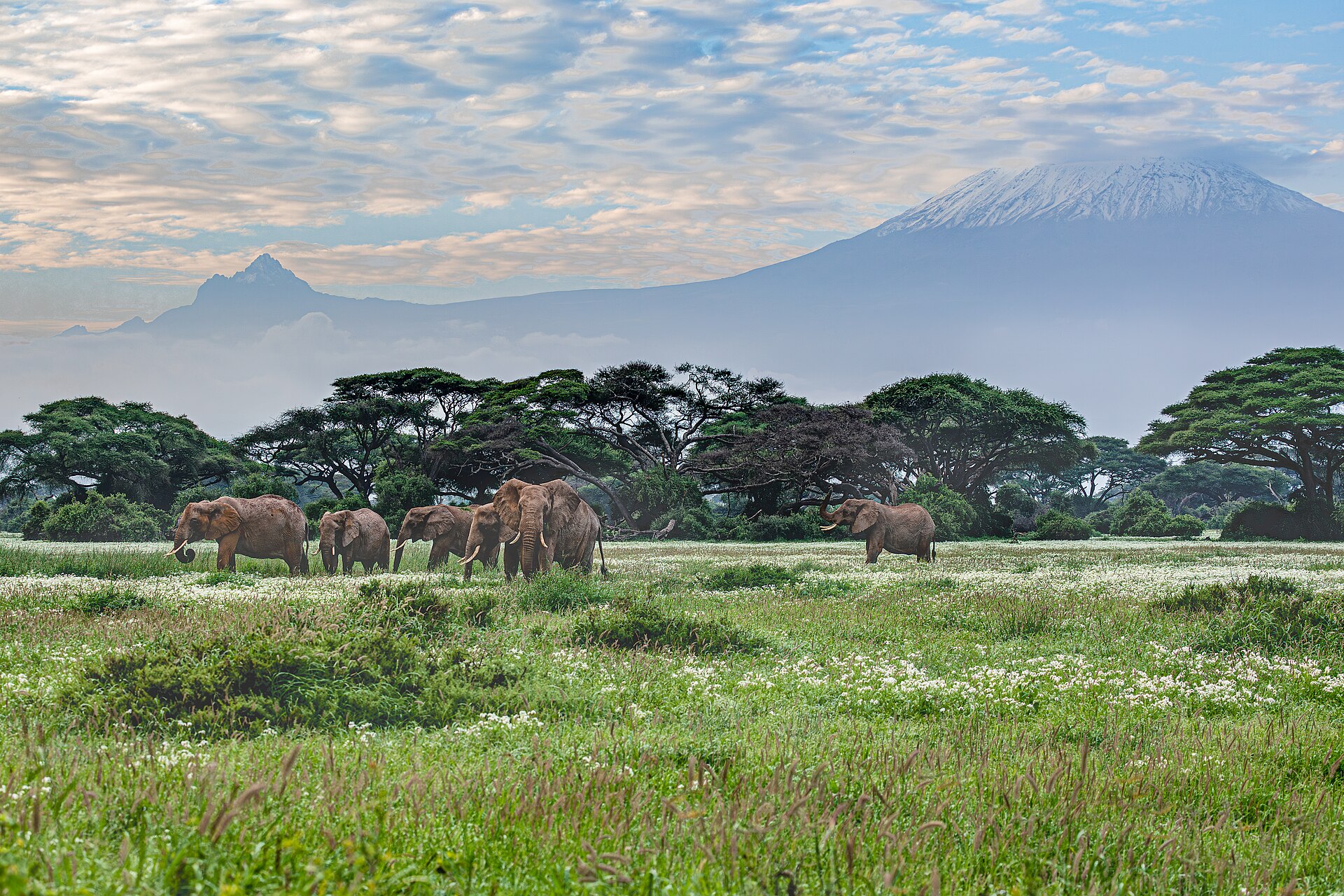
Kilimanjaro is the reason a lot of people come to Tanzania in the first place. At 5,895 metres, Uhuru Peak is the highest point in Africa and the summit of the tallest free-standing mountain on earth — a dormant volcano that rises alone from the plains rather than as part of a range. What sets it apart from the other great summits is that it asks for determination rather than technical skill. There are no ropes, no ice axes and no climbing experience required on the standard routes. If you can walk uphill for several days, you can attempt it. The mountain that stops people isn’t the terrain — it’s the altitude.
The peak most people call “Kilimanjaro” is one of three volcanic cones. Kibo, the flat-topped centre, carries the glaciers and the summit; jagged Mawenzi and the worn-down Shira plateau flank it. Every route funnels toward the same place — Uhuru Peak on Kibo’s crater rim — but the way each one gets there, and how well it prepares your body for the thin air up top, is what separates a good climb from a miserable one.
A trek, not a technical climb
It’s worth being clear about what Kilimanjaro is and isn’t. It’s a long, high-altitude walk — a “walk-up” in mountaineering terms — not an ascent that demands ropework or crampons on ice walls. That’s exactly why it draws people who have never climbed anything before. But “non-technical” is not the same as “easy.” You’ll walk five to nine days, cover long distances at low oxygen, and push through a summit night that starts around midnight in sub-zero cold. Fitness helps, and you should train for it, but the deciding factor is how your body handles the altitude — and that’s largely out of your control until you’re up there.
Climbing independently is not permitted. Every ascent must go through a licensed operator, with a guide team and porters who carry the camp, cook and monitor your health each day. That makes choosing the right operator the single most important decision of the whole trip — more important than which route you pick. A good outfit runs a sensible pace, carries oxygen and a pulse oximeter, and knows when to turn a struggling climber around. Browse Kilimanjaro tours to see how reputable operators structure their climbs.
The altitude is the whole game
Almost everyone who fails to summit fails because of altitude, not fitness. Above roughly 3,000 metres the body starts to feel the lack of oxygen, and how badly you feel depends less on how strong you are than on how much time you give yourself to adjust. The governing principle is simple: climb high, sleep low. Routes that let you gain height during the day and then drop back down to sleep give your body a chance to adapt, and they post markedly better summit success rates than routes that push straight up.
This is why day count matters so much. A five-day climb is cheaper and quicker, but it rushes the acclimatisation and a real share of climbers don’t make the top. Add a day or two and the odds jump. Many climbers also use Diamox (acetazolamide) to help their bodies acclimatise; it’s worth discussing with a doctor before you travel. The honest takeaway: budget more days than you think you need. The extra night on the mountain is the cheapest insurance you can buy against turning back a few hundred metres short.
Choosing your route
Kilimanjaro has several established routes, and they genuinely differ — in scenery, in how crowded they are, in how well they acclimatise you, and in price. There’s no single “best” one, only the best one for your budget, timeframe and appetite for company on the trail.
- Marangu, the so-called “Coca-Cola route,” is the only one with huts to sleep in and is often sold as a cheap five-day climb. It’s also the one with the weakest acclimatisation profile — you descend the same path you came up — and a lower success rate as a result.
- Machame, the “Whiskey route,” is the popular scenic choice: a camping route with a good climb-high-sleep-low profile, best done over seven days. Its popularity means you won’t be alone.
- Lemosho and the Northern Circuit trade time and money for the best acclimatisation and the highest success rates, on quieter, more remote trails.
- Rongai approaches from the drier northern side and stays gentler and calmer, a good bet in the wetter months.
For a full, honest comparison of the trade-offs — and help matching a route to the climber you actually are — read our guide to the best Kilimanjaro route.
Climbing through five worlds
One of the quiet pleasures of Kilimanjaro is how much changes underfoot. In a few days you walk through five distinct ecological zones, as if crossing from the equator to the Arctic in miniature. You start in the cultivated foothills of coffee and banana farms, climb into dripping montane rainforest loud with birds and colobus monkeys, then break out onto open heath and moorland dotted with giant lobelias. Higher still, the ground turns to alpine desert — cold, dry, lunar — before the final push onto the arctic zone of ice and rock at the summit. It’s a genuinely varied trek, not a slog up a single monotonous slope.
When to climb
There are two good windows, and one to avoid. January to March tends to be colder and clearer, with fewer people on the trails and a better chance of a snow-dusted summit. June to October is the long dry season, the most reliable and most popular time to climb. The long rains of April and May are best avoided — wet, muddy trails and clouded views — while the short rains around November are lighter and less disruptive. Whichever window you choose, expect the summit itself to be bitterly cold at any time of year.
Getting there, and what to pair it with
The gateway town is Moshi, a low-key place at the mountain’s foot where most climbers spend a night before and after the trek. The nearest airport is Kilimanjaro International (JRO), well connected to Arusha, Dar es Salaam and Nairobi. It’s worth remembering that Kilimanjaro is a trek, not a safari — the two are different experiences on different terrain — but they pair naturally, and plenty of visitors follow the climb with a few days on the northern safari circuit or a flight down to the coast to recover on the beaches of Zanzibar. See where to stay for the lodges and hotels around Moshi and Arusha that bookend a climb.
A word on porters
Your climb runs on the backs of porters — the men and women who carry the tents, food and gear so you can walk with a daypack. Their welfare is a real and long-standing issue on the mountain: underpaying, overloading and poorly equipping porters is common among the cheapest operators. Choosing a company that treats its crew fairly — for example, partners of the Kilimanjaro Porters Assistance Project (KPAP) — costs a little more and matters a great deal. It’s one of the clearest ways to tell an ethical operator from one racing to the bottom on price.
Ready to plan the climb? Compare Kilimanjaro tours, find where to stay before and after, or read our guide to the best Kilimanjaro route for your goals.


